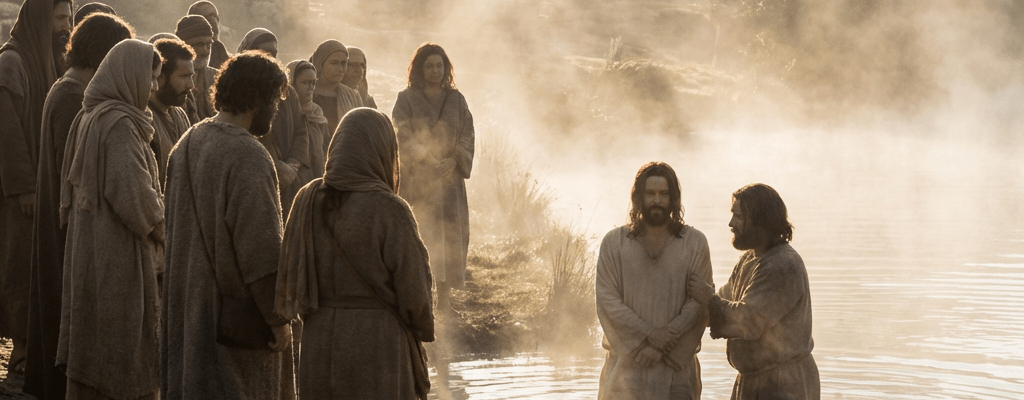

In this article we submit today, we see a contention in the relationship between the baptism of John the Baptist and the baptism instituted by Jesus in the Great Commission. While some argue for a singular, continuous “gospel of baptism” stretching from the Jordan River to the Book of Acts, a close examination of the biblical text reveals a profound theological and dispensational divide.
These arguments provide a thorough refutation of the “identity” theory, specifically addressing the cases of Apollos and the Ephesian disciples
1. The Case of Apollos: Accuracy vs. Completeness
Adherents to the view in question often cite Acts 18:24-26, noting that Apollos was “teaching accurately the things concerning Jesus” while only knowing the baptism of John. They argue that if he was “accurate,” his baptism must have been sufficient.
The text states that Priscilla and Aquila took him aside and explained the way of God “more accurately” (akribesteron). This comparative Greek term proves that while Apollos had the facts of Jesus’ life correct, his understanding was incomplete.
Apollos was preaching a message of anticipation. He knew Jesus was the Messiah, but he lacked the revelation of the Death, Burial, Resurrection, and the outpouring of the Spirit.
Accuracy regarding the Person of Jesus does not equal the completeness of the Work of Jesus. Apollos was a man of the transition; his subsequent ministry in Achaia only flourished after he moved beyond the limitations of John’s preparatory rite. Johns baptism couldn’t then- nor now, add one single soul to the body of Christ.
2. The Ephesian “Re-Baptism”: The Ultimate Refutation
Acts 19:1-7 serves as the definitive textual proof that the two baptisms are distinct. If John’s baptism were identical to Christian baptism, the Apostle Paul would be guilty of violating his own doctrine of “one baptism” (Ephesians 4:5). LET THAT SINK IN!
Paul’s first question to the disciples was, “Did you receive the Holy Spirit when you believed?” Their ignorance of the Spirit immediately alerted Paul that their baptism was not the baptism into Jesus and His gifts through the Spirits power.
Paul asks, “Into what then were you baptized?” This indicates that the object of baptism determines its validity. They were baptized into John’s repentance; Paul directed them to be baptized into the Name of the Lord Jesus.
Paul did not simply “top off” their faith with a prayer. He invalidated their previous immersion and commanded them to be baptized again. You do not re-administer a condition if the first instance was valid and identical.
3. Promise vs. Fulfillment
The argument that the “Gospel is the same from John to Jesus” ignores the Covenantal shift that occurred at the Cross. John’s baptism was directed toward a Messiah who was coming (Acts 19:4). It was a “check” written on a future account.
Jesus’ baptism is directed toward a Messiah who had arrived and conquered. It is the “cash” of a finished work. John’s baptism lacked the explicit invocation commanded by Jesus in Matthew 28:19. Christian baptism is a joining/marriage into the life and salvation of the Father, Son, and Holy Spirit—a revelation that was not fully manifested or functional as a baptismal requirement until after the resurrection and glorification of Christ.
4. The Mode vs. The Meaning
It is historically and textually accurate that both John and the Apostles practiced immersion in water. However, the mode of an ordinance does not define the essence of the ordinance.
The Jews already practiced Mikvah (ritual immersion) for purification. John did not invent immersion; he repurposed it by Gods divine handiwork. If “mode” determined identity, then John’s baptism would be the same as a Pharisee’s ritual bath.
Immersion in John’s Day was a sign of “preparing the way.” Immersion in Jesus’ name is a “burial and resurrection” (Romans 6:4). One is a washing of preparation; the other is a literal identification with a historical death and resurrection that had not yet occurred during John’s ministry.
5. The “Remission of Sins”
This is a most critical distinction to make concerning Mark 1:4.
John’s baptism offered remission of sins in the same way Old Testament sacrifices did—it was grounded in a future atonement. It looked forward to the “Lamb of God who takes away the sin of the world” (John 1:29). It was a “holding pattern” of grace.
Baptism in Jesus’ name applies the blood already shed. It is the formal entry into the New Covenant where sins are not just “passed over” (Romans 3:25), but are blotted out through the completed mediation of the High Priest, Jesus Christ.
6. The “Two Realities” Argument
Two things can look identical on the outside while being fundamentally different in spiritual reality. Even if the water and the “remission” language are present, John’s baptism is Spirit-less. As noted in Acts 19, the Ephesian disciples had been immersed for repentance, yet they were spiritually “incomplete” because they lacked the indwelling of the Holy Spirit and any subsequent gifts.
If John’s baptism was the same as Jesus’, then the Ephesians would have received the Spirit the moment they were baptized by John (or his followers). The fact that they didn’t proves that the “remission” in John’s baptism did not carry the New Covenant seal of the Spirit.
Hebrews 7:12 states, “For the priesthood being changed, of necessity there is also a change of the law.”
John’s baptism was authorized under the Levitical/Prophetic order.
Jesus’ baptism is authorized under the Melchizedek order.
Even if the “remission of sins” is the result of both, the legal basis for that remission shifted from the shadow of the Law, to the substance, that is Christ.
| Feature | John’s Baptism | Christian Baptism |
| External Mode | Immersion in Water | Immersion in Water |
| Stated Goal | Remission of Sins | Remission of Sins |
| Spiritual Reality | Anticipatory (Looking Forward) | Participatory (Union with Christ) |
| Agent of Grace | Repentance/Preparation | The Holy Spirit/The Blood |
| Covenantal Basis | Transition (Old ending) | Inauguration (New beginning) |
Remission of sins was available under the Old Covenant through animal sacrifice (Leviticus 4:26). Does that mean animal sacrifice is the same as the Cross? Of course not. Likewise, the “remission” in John’s baptism was a provisional grace, whereas the “remission” in Christian baptism is a positional reality in the Body of Christ. They share a goal, but they do not share a Covenant.
THEY ARE DIFFERENT.
 eastsidecocmorganton.com