
For many readers of the Bible, the four-hundred-year “silence” between Malachi and Matthew are shrouded in secrecy and mystery. However, Jewish history and the Bible reveal this period to be a masterclass in preparation.
God was not silent; He was setting the stage. To the casual observer, the transition from the majestic, instrumental pageantry of the Old Testament Temple to the simple, vocal worship of the New Testament Church seems like a jarring shift. However, a closer look at history and scripture reveals a “divine pivot.” This was too good to be coincidence.
God at Work
God used the synagogue as a transitional bridge, ensuring that when the Church was established, the platform for its operation was already in place. So, when the New Testament opens, the religious infrastructure of the Jewish people had undergone a radical shift that made the transition to the Lord’s church not just possible, but seamless. God’s fingerprint is all over this history.
From Temple Ritual to Synagogue Fellowship
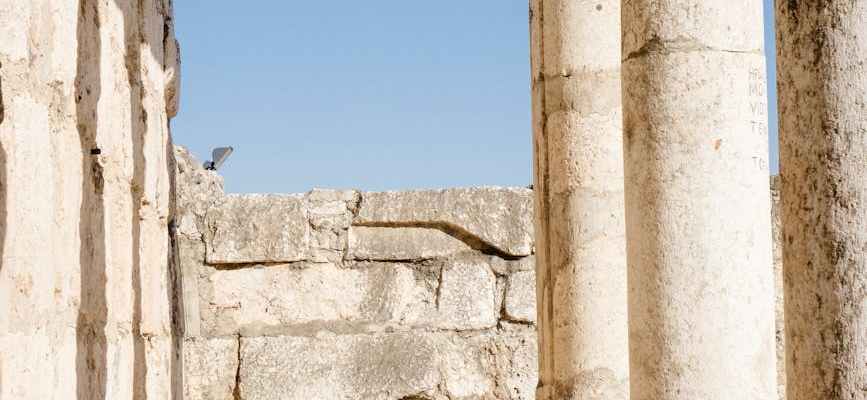
In the Old Testament, Jewish life revolved around the Temple in Jerusalem. It was a centralized, national system defined by animal sacrifice, a specific physical location, and a hereditary priesthood. However, during the Babylonian exile and the subsequent intertestamental period, the Synagogue emerged. All over the eastern world synagogues were erected for the Jewish people who were scattered abroad.
By the first century, the synagogue had become the primary platform for Jewish spiritual life. This shift provided the exact organizational DNA that the New Testament church would grow out of.
- Localization: Unlike the Jerusalem Temple, synagogues were local. Wherever ten Jewish men gathered, a synagogue could be formed.
- Autonomy: Each synagogue functioned as an independent unit, governed by local leaders rather than a distant central hierarchy.
- Leadership: Synagogues were led by a plurality of men (often called “rulers of the synagogue”), creating a direct precedent for the New Testament model of local, autonomous congregations led by elders (Acts 14:23; Titus 1:5). Nothing from male leadership, to baptism (already practiced by Jews, the Temple was surrounded by baptismal pools…look into them, google Mikva’ot, or Mikveh) or worship was just arbitrarily dropped onto God’s people. He masterfully prepared them.
The Instrumental Distinction: Temple vs. Synagogue
One of the most striking similarities between the synagogue and the early church is the absence of mechanical instruments of music. While the Temple was famous for its grand orchestras, the synagogue remained strictly a cappella.
This was not an accident, but a matter of divine authority. As noted in the Encyclopedia Judaica, the authority for instrumental music in Jewish worship was strictly “relegated to the Levites only, and to be in the Temple only.”
“Late Hellenistic civilization made music an all-penetrating cultural activity. The Eastern scene was dotted with theaters, arenas, and circuses where singers and virtuosos flocked together at musical contests (organized even by Herod; Jos., Ant., 15:269ff.; 16:137). Amateur philosophers at social gatherings of every kind discussed music. Jingling, banging, and rattling accompanied heathen cults, and the frenzying shawms of a dozen ecstatic rites intoxicated the masses. Amid this euphoric farewell feast of a dying civilization, the voices of non-conformists were emerging from places of Jewish and early Christian worship; *Philo of Alexandria had already emphasized the ethical qualities of music, spurning the “effeminate” art of his gentile surroundings. In the same spirit, early synagogue song intentionally foregoes artistic perfection, renounces the playing of instruments, and attaches itself entirely to “the word” – the text of the Bible. The new style of Jewish music made its appearance at a specific and fateful moment. When the destruction of the Temple in 70 C.E. demanded a complete rearrangement in the religious, liturgical, and spiritual fields, music became involved in several ways. The abolition of Temple worship also put an end to the refined instrumental art of the Levites. The use of instruments in the synagogue service was prohibited (and remained so, with certain exceptions), leaving music a strictly vocal art. Needless to say, this limitation left its imprint on musical style and form. Moreover, the musical skill of the Levitic singers and their tradition, accumulated over generations, were not utilized in synagogue song, and their professional teaching and rules had not survived in writing. Synagogue song was thus a new beginning in every respect –especially with regard to its spiritual basis.”
Judaica Encyclopedia, Volume 14, pg.643
When God established the Temple service, the instruments were tied to the Levitical priesthood and the sacrificial system. They were never authorized for the general assembly of the people in their local gatherings (1 Chronicles 25:1; 2 Chronicles 29:25). In layman’s terms, not just anyone could play a musical instrument in worship to God, not any instrument could be used, and not just anywhere was authorized. God is and always has been very specific and detailed. None can approach God “willy-nilly” (Psalm 89:7).
The Finality of the Transition
In AD 70, the Roman legions destroyed the Temple in Jerusalem. This was more than a military defeat; it was a providential closing of a door (Matthew 24:2). The proverbial nail in the coffin so to speak.
With the Temple gone, the Levitical priesthood had no place to serve, and the sacrificial system ceased. Consequently, the biblical authority for instrumental worship—which was tethered exclusively to that system—vanished. You see, all the records of who men were, their lineage, which had to be proven to serve in the Priesthood, all the records of land ownership, it was all burned and completely destroyed. This was God putting an end, and that with finality, to the Jewish religion.
However, the “seamless transition” was already complete. The followers of Christ did not have to invent a new way to worship or organize. They simply continued the pattern God had cultivated in the synagogue:
- A focus on the Word (Scripture reading and exhortation).
- A local, autonomous structure (Elders leading, Deacons serving: 1 Timothy 3; Titus 1)
- Spiritual sacrifice (The “fruit of our lips” rather than the blood of bulls: Hebrews 13:15; 1 Peter 2:5).
When the Apostles began planting churches, they did not have to teach the early Jewish converts a brand-new way to assemble. The converts already understood and much of what they did would have been painlessly natural to them. The difference was recognizing Christ as the Messiah they had awaited, that their scriptures had attested to, and His sacrifice being all sufficient, In that, they could focus on the spiritual nature of God’s new covenant of faith and grace.
A Pattern for All Time
The transition from Judaism to Christianity was not a chaotic break from tradition, but the fulfillment of a divine design. God used the synagogue to wean the people off the centralized, instrumental, and sacrificial shadows of the Law, preparing them for the local, vocal, and spiritual reality of the Church.
Don’t you see the wisdom and splendor of God in His mode of operation as He prepared His people for the promise of change (Jeremiah 31:31; Hebrews 8:10-13)? I hope you also see, that it is Jewish history that attests to the strictly vocal nature of worship outside of the temple- the temple which God destroyed. That isn’t “church of Christ doctrine”, that is history as recorded in their encyclopedia.
When the New Testament commands Christians to “sing and make melody in your heart” (Ephesians 5:19), it isn’t a new restriction—it is the continuation of the simple, reverent, and authorized pattern that God had been perfecting for centuries.
If we at the Eastside church of Christ can help you know God, please, afford us the opportunity open our Bibles together.
Check out our website or YouTube channels:
https://www.youtube.com/@eastsidechurchofchristmorg6930
God loves you and we do too.
 eastsidecocmorganton.com